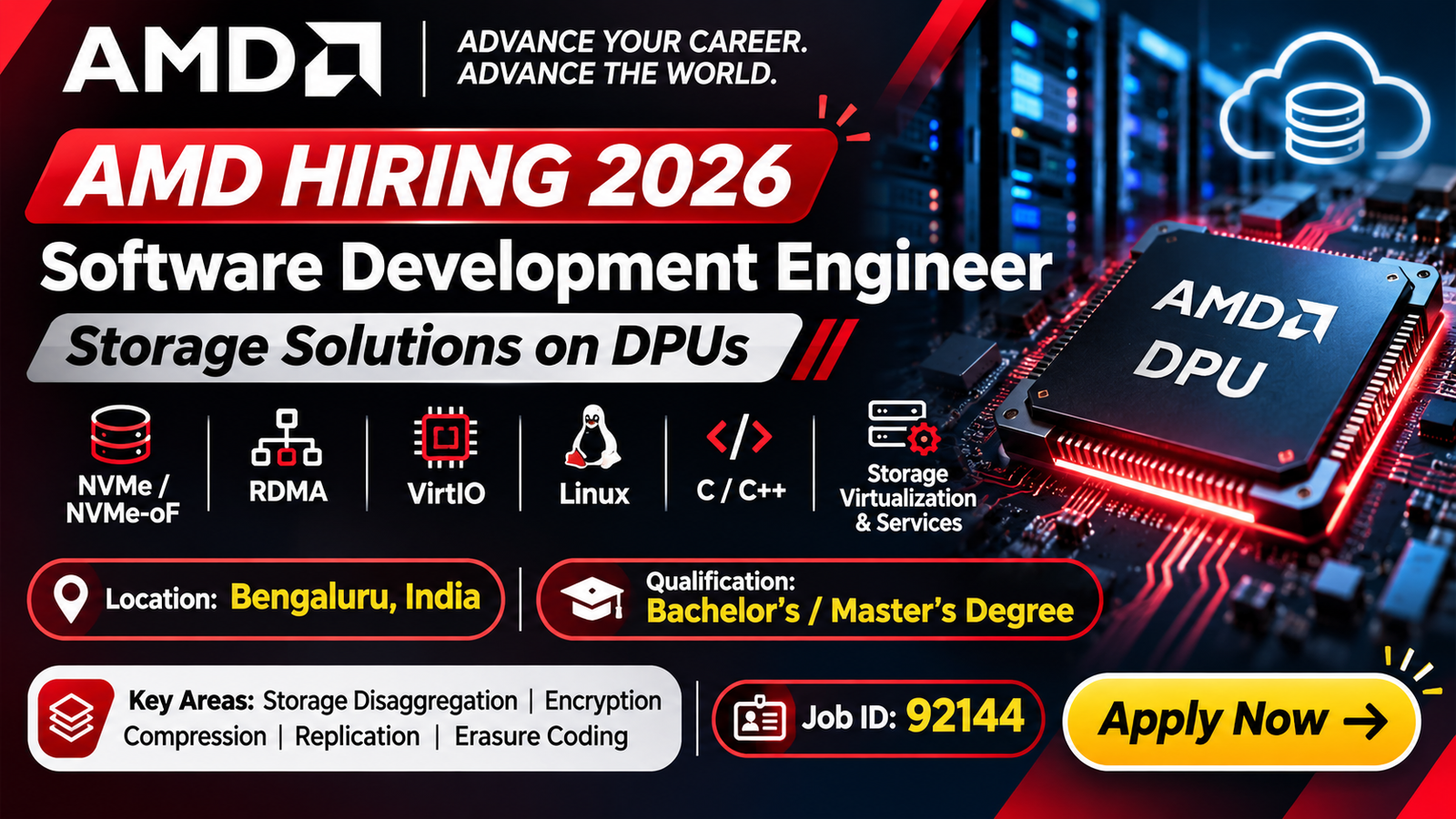
AMD Software Development Engineer Recruitment 2026 offers an opportunity for experienced and technically skilled candidates interested in high-performance storage systems, C/C++ programming, cloud infrastructure and Data Processing Unit (DPU) technologies. Advanced Micro Devices (AMD) has advertised a Software Development Engineer – Storage Solutions on DPUs position in Bengaluru, Karnataka, India.
The job description identifies the role as MTS Software Development Engineer, with responsibilities involving the architecture, design, development and optimization of advanced storage technologies.
The AMD Software Development Engineer position focuses on technologies such as NVMe, PCIe, NVMe-over-Fabrics, RDMA, TCP and VirtIO, along with storage virtualization and services such as encryption, compression and replication.
Selected engineers may collaborate with AMD’s architecture specialists, develop innovative software solutions, participate in hardware bring-up activities and investigate complex technical problems.
The employer is looking for candidates with strong C/C++ programming skills, systems programming knowledge and experience relevant to storage technologies.
Applicants should have a bachelor’s or master’s degree in Computer Science, Computer Engineering, Electrical Engineering or an equivalent field.
Candidates can review the complete eligibility requirements, technical skills, job responsibilities, salary information, preparation guidance and official application process below.
AMD Software Development Engineer Recruitment 2026 – Job Overview
| Job Details | Information |
|---|---|
| Company Name | Advanced Micro Devices (AMD) |
| Job Title | Software Development Engineer – Storage Solutions on DPUs |
| Role in Description | MTS Software Development Engineer |
| Job Requisition ID | 92144 |
| Recruitment Year | 2026 |
| Job Category | Engineering |
| Job Location | Bengaluru, Karnataka, India |
| Work Arrangement | Not Explicitly Specified in Supplied Description |
| Qualification | Bachelor’s or Master’s Degree |
| Eligible Fields | Computer Science, Computer Engineering, Electrical Engineering or Equivalent |
| Minimum Experience | Not Specified Numerically |
| Fresher Eligibility | Not Explicitly Confirmed |
| Graduation Batch | Not Specified |
| Salary / CTC | Not Disclosed |
| Main Programming Languages | C / C++ |
| Primary Technology | Data Processing Units (DPUs) |
| Storage Technologies | NVMe, NVMe-oF, VirtIO |
| Networking Technologies | RDMA, TCP, PCIe |
| Storage Services | Encryption, Compression, Replication, Erasure Coding |
| Operating System Knowledge | Linux Block Layer and Device Drivers |
| Virtualization | QEMU/KVM Exposure – Advantage |
| Development Tools | Debuggers, GitHub, Profilers |
| Additional Knowledge | Concurrent Programming, Threading |
| Application Mode | Online |
| Official Recruitment Portal | AMD Careers |
| Last Date to Apply | Not Specified |
Important: The title and responsibilities indicate a specialized engineering position. AMD does not explicitly classify this opening as a fresher recruitment drive.
About AMD – Company Overview
Advanced Micro Devices, commonly known as AMD, is a global technology company specializing in high-performance and adaptive computing products.
The company develops processors, graphics technologies, AI accelerators, embedded computing solutions and infrastructure technologies used across multiple industries.
AMD products support personal computers, data centers, gaming, artificial intelligence, scientific computing and enterprise systems.
The company is also involved in technologies that improve how computing systems process, transfer and store information.
Modern data centers need more than powerful processors.
They also require efficient networking, storage access, virtualization and security infrastructure.
Technologies such as Data Processing Units can help manage some of these infrastructure functions.
AMD’s Pensando DPU portfolio is one example of its work in this area.
DPUs are specialized processors designed to handle infrastructure tasks such as networking, storage and security processing.
By assigning appropriate workloads to specialized hardware, systems can reduce the amount of infrastructure processing handled by general-purpose CPUs.
This can support efficiency in cloud and AI environments.
The AMD Software Development Engineer position is relevant to this broader area of infrastructure software engineering.
However, the advertisement does not explicitly name a particular AMD Pensando product as the selected engineer’s assignment.
Candidates can learn more through the official AMD website and AMD Careers.
AMD Software Development Engineer – Job Description
The advertised role involves developing storage solutions designed to operate with DPUs.
AMD is seeking a specialized software engineer who understands systems programming, storage technologies and performance optimization.
The engineer will contribute to solutions involving NVMe over PCIe, NVMe-over-Fabrics using TCP or RDMA and VirtIO.
These technologies are relevant to moving information efficiently between computing systems and storage devices.
The position also includes work involving storage disaggregation and virtualization.
Storage disaggregation allows computing resources and storage resources to be managed separately rather than being permanently combined within the same physical server.
This can provide flexibility in large infrastructure environments.
The job description also mentions implementing storage capabilities such as encryption, compression, replication and erasure coding.
Candidates should be comfortable developing high-quality code and investigating complex technical issues.
The role includes collaborating with architecture specialists and participating in ASIC or hardware bring-up activities.
AMD also values contributions to patents, technical standards and open-source initiatives.
The selected engineer will be expected to follow relevant industry developments and evaluate ways to improve system performance.
AMD Software Development Engineer Eligibility Criteria 2026
Candidates interested in AMD Software Development Engineer Recruitment 2026 should review the educational and technical requirements carefully.
Educational Qualification
AMD identifies a bachelor’s or master’s degree in a relevant technical discipline.
The specified fields are:
- Computer Science.
- Computer Engineering.
- Electrical Engineering.
- An equivalent field.
The job description does not provide a separate list of all accepted Indian degree titles.
Candidates holding B.E., B.Tech, M.E. or M.Tech degrees in corresponding fields can review the opportunity, but the employer determines whether an individual qualification satisfies its requirements.
Is a Master’s Degree Mandatory?
No. The advertisement allows either a bachelor’s or master’s degree in a relevant discipline.
A postgraduate degree is not explicitly required for every applicant.
Minimum Experience Requirement
The job description does not specify a numerical minimum, such as two, three or five years of professional experience.
However, it asks for specialized knowledge of storage systems, C/C++, systems programming and modern infrastructure technologies.
The description also expects the ability to resolve sophisticated engineering problems.
Candidates should therefore assess whether they have relevant practical experience.
Are Freshers Eligible?
AMD does not explicitly confirm that freshers are eligible for this particular opening.
The role is identified as MTS Software Development Engineer and involves architecture, performance optimization and advanced storage engineering.
It should not be advertised as a confirmed zero-experience or campus hiring position.
Candidates without professional experience should review the technical requirements and check their eligibility directly with AMD.
Eligible Graduation Batch
The advertisement does not mention specific eligible graduation years.
Applicants should not assume that 2024, 2025, 2026 or 2027 graduates are automatically eligible.
Minimum CGPA or Percentage
The supplied job description does not specify a minimum academic percentage or CGPA.
Candidates should rely on the official recruitment portal for any additional academic screening conditions.
Job Location
The advertised location is Bengaluru, Karnataka, India.
The supplied job description does not explicitly confirm a remote or hybrid work arrangement.
Applicants should verify office attendance and relocation expectations with the employer.
Technical Skills Required for AMD Software Development Engineer
The AMD Software Development Engineer position focuses on high-performance programming, storage protocols, virtualization and infrastructure development.
1. C Programming
C is an important programming language for systems-level development.
Candidates should understand pointers, memory management, data structures, functions and low-level programming concepts.
Knowledge of how software interacts with operating systems and hardware can be particularly useful.
Developers should be comfortable investigating memory-related issues and writing reliable code.
2. C++ Programming
AMD specifically expects a strong object-oriented programming background using C/C++.
Candidates should understand classes, objects, inheritance, polymorphism, templates and modern C++ language features.
They should also understand resource management, performance considerations and debugging.
High-performance systems software often requires careful control over resource usage.
3. Systems Programming
Systems programming involves developing software that interacts closely with operating systems, hardware and infrastructure components.
The advertised role requires a strong background in this area.
Relevant knowledge may include operating system concepts, memory management, concurrency, I/O operations and hardware interfaces.
Candidates should understand how system-level software behaves under demanding workloads.
4. NVMe Technology
NVMe stands for Non-Volatile Memory Express.
It is a storage protocol designed for accessing non-volatile storage, particularly devices such as solid-state drives.
NVMe commonly uses PCIe connectivity for high-performance communication.
Candidates with storage engineering experience should understand the basic NVMe architecture and how software communicates with storage devices.
5. PCIe
Peripheral Component Interconnect Express, commonly known as PCIe, is a high-speed interface used to connect hardware components.
NVMe storage devices frequently use PCIe.
Knowledge of PCIe can be relevant when investigating performance, communication and hardware integration.
The AMD job specifically mentions NVMe-PCIe solutions.
6. NVMe-over-Fabrics
NVMe-over-Fabrics, abbreviated as NVMe-oF, extends NVMe communication across supported network fabrics.
This allows storage to be accessed across a network instead of relying only on a local PCIe connection.
The position mentions NVMe-oF over TCP and RDMA.
Candidates should understand the general purpose of remote storage access and the performance considerations involved.
7. RDMA
Remote Direct Memory Access, or RDMA, is a technology that enables memory-related data transfers between systems with reduced CPU involvement in supported environments.
It can be useful in high-performance computing and storage networking.
AMD identifies RDMA as relevant to the advertised storage solutions.
8. TCP Networking
Transmission Control Protocol is a widely used network transport protocol.
NVMe-over-TCP uses standard TCP/IP networking to support remote NVMe storage access.
Candidates should understand basic networking concepts such as connections, packets, latency and throughput.
Strong networking fundamentals are useful when debugging distributed storage performance.
9. VirtIO
VirtIO is a virtualization interface used to provide efficient virtual devices in supported virtualized environments.
It can be relevant to virtual storage systems and cloud infrastructure.
The AMD position includes VirtIO-based solutions among its responsibilities.
Candidates familiar with virtual machines and device interfaces may find this knowledge useful.
10. Storage Disaggregation
Storage disaggregation separates computing resources from storage resources.
Instead of requiring every server to depend exclusively on storage directly attached to it, a system can access appropriate storage resources across an infrastructure environment.
This can support flexible resource allocation and scalability.
AMD explicitly includes storage disaggregation among the areas where engineers will develop solutions.
11. Storage Virtualization
Storage virtualization provides ways to manage physical storage resources through abstracted software interfaces.
This can help infrastructure platforms organize storage capacity and provide it to applications.
Candidates should understand how virtualization affects performance and resource management.
12. Linux Block Layer
The Linux block layer is associated with handling block-device I/O operations within the operating system.
Understanding this component can help engineers investigate how storage requests move through a Linux system.
The advertisement lists Linux block-layer exposure as an advantage.
13. Device Drivers
Device drivers allow operating systems to communicate with hardware components.
AMD mentions storage-related drivers for Linux, ESXi and Windows among the advantageous areas of experience.
Candidates familiar with device-driver development should highlight relevant work accurately.
14. QEMU and KVM Virtualization
The job description refers to virtualization technologies using the wording “QUEM/KVM.”
The commonly used technology names are QEMU and KVM.
QEMU is used for machine emulation and virtualization, while KVM provides virtualization capabilities within Linux.
Understanding virtual machine environments may help engineers work with virtualized storage devices.
15. SCSI and iSCSI
SCSI is a family of commands and interfaces associated with storage devices.
iSCSI allows SCSI commands to be transported over IP networks.
AMD identifies SCSI/FCP and iSCSI experience as desirable.
Candidates with storage networking backgrounds may find this experience relevant.
16. Encryption
Encryption protects information by converting it into a form that requires appropriate authorization to interpret.
Storage encryption can be important for protecting information in infrastructure systems.
The role includes encryption among the storage services that engineers may develop.
17. Compression
Compression reduces the amount of data required to represent information.
In storage systems, compression can affect capacity usage and performance.
Engineers may need to evaluate trade-offs involving processing overhead and storage efficiency.
18. Replication
Replication involves maintaining additional copies of data or related system state.
It can be used to support certain reliability and availability objectives.
The AMD position includes replication among its storage services.
19. Erasure Coding
Erasure coding is a method of protecting data against certain failures using encoded fragments.
It can provide an alternative to storing complete replicas, depending on the system design.
Candidates interested in distributed storage may benefit from understanding its basic principles.
20. Concurrent Programming and Threading
The employer expects experience with modern concurrent programming and threading APIs.
Concurrent software can perform multiple tasks or operations within the same system.
Developers should understand synchronization, race conditions, deadlocks and thread-safe programming practices.
These concepts can be especially important in high-performance systems.
AMD Software Development Engineer – Roles and Responsibilities
The job description identifies several engineering responsibilities.
Architect and Design DPU Storage Solutions
The selected engineer will contribute to the architecture and design of storage solutions that operate with DPUs.
This may involve evaluating protocols, software components and performance requirements.
Develop NVMe and NVMe-oF Solutions
The role includes developing software involving NVMe over PCIe and NVMe-over-Fabrics.
These systems support access to storage devices and resources.
Build VirtIO Storage Capabilities
Engineers may work on storage solutions relevant to virtualized cloud environments.
VirtIO can be part of how virtual machines interact with virtual devices.
Develop Storage Services
The advertised responsibilities include building solutions involving encryption, compression, replication and erasure coding.
Such features support different storage security, efficiency and resilience requirements.
Solve Storage Disaggregation Challenges
The employer expects engineers to address technical problems involving separated computing and storage resources.
These systems can introduce complex performance and reliability considerations.
Improve Software Performance
The role involves improving important applications and benchmarks.
Engineers should use appropriate measurements to understand bottlenecks and evaluate optimizations.
Collaborate With Architecture Specialists
AMD expects the engineer to work with specialists developing future products.
This collaboration can help align software functionality with evolving hardware capabilities.
Participate in ASIC and Hardware Bring-Up
ASIC bring-up involves preparing, validating and investigating newly developed hardware.
The job includes participation in ASIC and other hardware bring-up activities.
Debug Existing Software Issues
Engineers will investigate software defects and identify appropriate corrections.
They may also research alternative implementations that improve efficiency.
Contribute to Patents and Open Source
AMD identifies potential contributions to patents, industry standards and open-source initiatives.
Such contributions depend on the assigned engineering work and applicable company policies.
Follow Technology Developments
The company expects engineers to remain informed about software and hardware advances, particularly in algorithms and system architecture.
Build Technical Relationships
The role requires collaboration with colleagues and partners.
Strong technical communication helps teams solve complex engineering problems.
What Is a Data Processing Unit (DPU)?
A Data Processing Unit is a specialized processor designed to handle infrastructure-related work.
Modern servers execute many different tasks.
Some tasks support the main application, while others manage networking, storage, security and data movement.
A DPU can handle selected infrastructure functions so that general-purpose CPUs and other processors can focus on their primary workloads.
This can be useful in cloud computing and AI data centers where data movement and system efficiency are important.
AMD’s Pensando DPU technologies include capabilities associated with networking, storage acceleration and security.
However, the specific product assignment for this vacancy is not confirmed in the job description.
What Is the Difference Between NVMe and NVMe-over-Fabrics?
NVMe is a protocol commonly used for high-performance access to non-volatile storage devices.
NVMe-over-Fabrics extends NVMe access across supported networks.
For example, a locally connected SSD may communicate over PCIe.
A remote storage system can use a supported NVMe-oF transport to access storage across a network.
NVMe-oF over TCP uses TCP/IP networking.
NVMe-oF over RDMA uses an RDMA-capable transport.
The choice of architecture can affect performance, operational complexity and infrastructure requirements.
AMD specifically lists these technologies in the storage engineering role.
How Are DPUs Used in Cloud and AI Infrastructure?
Cloud and AI systems can involve large amounts of network and storage traffic.
Applications may need to move information between servers, storage devices and processing components.
A DPU can support infrastructure operations such as networking, storage acceleration and security processing.
This may help reduce certain host CPU workloads.
For demanding applications, reducing unnecessary infrastructure overhead can be useful.
AMD’s DPU portfolio includes technologies associated with high-performance data movement and storage services.
The advertised software engineering role is focused on building relevant storage functionality for cloud and AI use cases.
Why Are C and C++ Important in Storage Engineering?
Storage systems require software that can operate reliably while managing data movement and system resources.
C and C++ are widely used in systems programming because they provide tools for controlling memory, data structures and low-level operations.
A storage engineer may need to understand how I/O requests are represented and processed.
They may also investigate how concurrency, locking and memory handling affect application behavior.
In high-performance systems, small implementation decisions can influence throughput, latency and reliability.
This helps explain why AMD emphasizes strong C/C++ programming knowledge.
What Is Storage Disaggregation?
Storage disaggregation is an infrastructure design approach in which storage and computing resources are separated.
Traditional systems may rely heavily on storage attached directly to an individual server.
A disaggregated design can allow computing resources to access suitable storage resources across a network.
This can help organizations manage storage capacity more flexibly.
However, remote storage access introduces challenges involving network behavior, data movement, performance and reliability.
Technologies such as NVMe-over-Fabrics can support these environments.
AMD identifies storage disaggregation as a major area for software development in this position.
AMD Software Development Engineer Salary 2026
The supplied AMD job description does not disclose a salary or annual CTC for Job ID 92144.
No fixed salary range, monthly in-hand compensation, joining bonus or equity allocation is specified.
Candidates should not treat salary estimates from third-party recruitment websites as officially confirmed compensation.
The final package will depend on the terms offered by AMD.
Applicants should request written compensation information before accepting an offer.
Official Salary / CTC: Not Disclosed.
AMD Software Development Engineer Job Location
The advertised location is Bengaluru, Karnataka, India.
The posting is associated with AMD’s Engineering category.
The supplied official description does not explicitly state a hybrid or fully remote work policy.
Candidates should confirm office attendance and other working arrangements with AMD.
Applicants who would need to relocate should also clarify applicable employment terms before accepting an offer.
How to Prepare for AMD Software Development Engineer Recruitment 2026
AMD does not provide a specific technical assessment syllabus for Job ID 92144.
However, candidates can prepare using the technologies described in the position.
Step 1: Strengthen C and C++ Programming
Revise memory management, pointers, classes, templates, concurrency and systems-level programming.
Practice writing code that is both correct and efficient.
Step 2: Review Storage Protocols
Study the basic architecture of NVMe and NVMe-over-Fabrics.
Understand how NVMe-over-TCP differs from local NVMe access.
Step 3: Study Linux Storage Concepts
Review the Linux block layer, storage devices and basic I/O behavior.
Understand how software interacts with storage devices through operating system components.
Step 4: Learn Virtualization Fundamentals
Revise virtual machines, VirtIO, QEMU and KVM.
Be prepared to explain how virtualization can affect device access.
Step 5: Review Networking
Practice TCP/IP fundamentals and learn how networking behavior affects storage traffic.
If you have worked with RDMA, prepare relevant examples.
Step 6: Study Storage Services
Understand the basic purposes of encryption, compression, replication and erasure coding.
Consider their performance and reliability trade-offs.
Step 7: Practice Performance Analysis
Learn how to investigate application performance using measurements and profiling tools.
Be able to explain how you would identify a bottleneck.
Step 8: Review Concurrent Programming
Study threads, synchronization, race conditions and locking.
Practice explaining how you would detect and resolve concurrency problems.
Step 9: Prepare Relevant Projects
Organize examples from your work involving systems software, storage, virtualization or networking.
Explain the requirements, technical challenges and your contributions.
These preparation suggestions are based on the advertised role, not a confirmed AMD interview syllabus.
Suggested Portfolio Projects for AMD Software Engineer Applicants
The following project ideas may help candidates demonstrate relevant knowledge. They are not mandatory assignments from AMD.
Project 1: C++ Multithreaded Application
Build an application that processes work using multiple threads.
Document synchronization methods and performance observations.
Project 2: Linux Storage Performance Study
Use a suitable test environment to examine the performance of storage operations.
Record measurements and explain possible bottlenecks.
Project 3: TCP Client-Server Application
Create a simple networking application using sockets.
Practice handling connections, errors and data transfer.
Project 4: Virtual Machine Storage Experiment
Experiment with a controlled QEMU/KVM environment.
Study how virtual storage devices are configured and exposed to a guest operating system.
Project 5: Data Replication Prototype
Build a small educational prototype that stores and copies data between test components.
Document how errors are detected and how consistency is maintained.
Resume Tips for AMD Software Development Engineer
Applicants should present technical knowledge and project experience clearly.
Highlight C/C++ Expertise
Describe relevant professional or project work involving C and C++.
Focus on your actual contributions.
Showcase Systems Programming Experience
Include work involving operating systems, networking, performance or low-level software.
Mention Storage Technologies
If you have experience with NVMe, NVMe-oF, RDMA, VirtIO or related protocols, describe the relevant projects.
Include Linux and Virtualization
Mention practical knowledge of Linux, device drivers or virtualization where applicable.
Demonstrate Debugging Ability
Explain technical problems you investigated and how you verified their solutions.
Highlight Collaboration
The role involves working with architecture specialists and technical partners.
Include accurate examples of team-based engineering work.
Keep Your Resume Accurate
Do not claim storage protocol or hardware experience that you cannot demonstrate.
The employer values technical depth and problem-solving ability.
AMD Software Development Engineer Selection Process
The official job description does not publish a fixed recruitment process for this position.
It does not confirm the number of technical interviews, coding assessments or other selection stages.
Candidates should apply through AMD Careers and follow any further instructions provided by the recruiting team.
Because the role emphasizes specialized systems engineering, applicants may find it useful to prepare examples involving C/C++, storage protocols, Linux, concurrency and performance optimization.
However, these are preparation suggestions, not confirmed interview questions.
How to Apply for AMD Software Development Engineer Recruitment 2026
Interested candidates should apply through the official AMD Careers website.
Step-by-Step Application Process
- Open the official AMD Software Development Engineer job listing.
- Verify that Job ID 92144 is still accepting applications.
- Review the educational qualifications and technical requirements.
- Confirm that the Bengaluru position matches your location preferences.
- Select the application option shown on the AMD Careers portal.
- Sign in or create a candidate profile if required.
- Enter the requested personal, educational and professional information.
- Upload an updated résumé if prompted.
- Describe relevant C/C++, systems programming and storage engineering experience accurately.
- Review your information before submitting.
- Save any application confirmation provided by AMD.
Official Apply Now Link
APPLY NOW – AMD SOFTWARE DEVELOPMENT ENGINEER
Company: AMD
Job Role: Software Development Engineer – Storage Solutions on DPUs
Job ID: 92144
Location: Bengaluru, India
Job Category: Engineering
If the direct page is unavailable, visit AMD Careers and search for Job ID 92144.
Frequently Asked Questions – AMD Software Development Engineer
1. Is AMD hiring Software Development Engineers in Bengaluru?
AMD has advertised a Software Development Engineer – Storage Solutions on DPUs position in Bengaluru under Job ID 92144.
2. What is the AMD job ID?
The job ID is 92144.
3. What is the job location?
The advertised location is Bengaluru, Karnataka, India.
4. What does MTS mean in the job description?
The position is identified as MTS Software Development Engineer. MTS is commonly used for Member of Technical Staff in engineering organizations.
5. What qualification is required?
A bachelor’s or master’s degree in Computer Science, Computer Engineering, Electrical Engineering or an equivalent field.
6. Are B.Tech graduates eligible?
Candidates holding relevant B.Tech qualifications can review the role, but AMD determines degree equivalence and final eligibility.
7. Is a master’s degree mandatory?
No. The listing accepts bachelor’s or master’s degrees in relevant disciplines.
8. Are freshers eligible?
Fresher eligibility is not explicitly confirmed. The role requires specialized systems and storage engineering knowledge.
9. What experience is required?
The advertisement does not specify a numerical minimum. Relevant storage and systems programming experience is preferred.
10. Which programming languages are important?
C and C++ are central to the advertised requirements.
11. What is a DPU?
A Data Processing Unit is a specialized processor used to handle selected infrastructure workloads such as networking, storage and security.
12. What is NVMe?
NVMe is a protocol used for high-performance access to non-volatile storage devices.
13. What is NVMe-over-Fabrics?
NVMe-oF extends NVMe storage access across supported network fabrics.
14. Is RDMA knowledge useful?
Yes. RDMA appears among the relevant storage and networking technologies.
15. Is Linux knowledge necessary?
Strong systems programming is important, and exposure to the Linux block layer and device drivers is listed as an advantage.
16. Is virtualization experience useful?
Yes. The advertisement mentions VirtIO and QEMU/KVM-related virtualization exposure.
17. Does the role involve AI?
The advertised storage solutions support cloud and AI use cases. The role is focused on infrastructure software rather than developing AI models.
18. Does the position include hardware work?
The responsibilities include participating in ASIC and hardware bring-up activities.
19. Is this an on-site role?
The supplied description confirms Bengaluru as the location but does not explicitly state the official working arrangement. Applicants should verify the schedule directly with AMD.
20. What is the salary?
The official job description does not disclose a salary or CTC.
21. Which graduation batches are eligible?
No specific graduation years are stated.
22. What is the minimum CGPA?
The advertisement does not provide a minimum CGPA.
23. What is the selection process?
No fixed interview or assessment stages are specified in the supplied job description.
24. What is the last date to apply?
No application deadline is provided.
25. Where can applicants apply?
Candidates can apply through AMD’s official careers portal using Job ID 92144.
Important Instructions for Applicants
Candidates should review the technical requirements carefully.
The advertised position focuses on systems programming, high-performance storage and DPU-based infrastructure development.
It is not confirmed as a fresher recruitment drive.
Applicants should not assume that a specific salary, minimum experience level or graduation-year eligibility applies unless AMD confirms it.
Use only official recruitment channels.
AMD warns applicants about recruitment scams and states that legitimate recruiters do not demand application fees.
Candidates should verify suspicious communications through the company’s official website.
Explore More Software Engineering Jobs
Candidates interested in other engineering and technology opportunities can explore:
Honeywell Internship 2026 – Chennai | Eligibility and Apply Online
Visit TeluguNewzz for more software developer jobs, semiconductor opportunities, engineering vacancies and technology recruitment updates.
Final Thoughts on AMD Software Development Engineer Recruitment 2026
The AMD Software Development Engineer position offers an opportunity for candidates with strong systems programming and storage engineering knowledge.
The role is based in Bengaluru and focuses on developing DPU-based storage capabilities for cloud and AI infrastructure.
Relevant technologies include C/C++, NVMe, NVMe-over-Fabrics, RDMA, TCP, VirtIO, Linux and virtualization.
The employer seeks candidates who can design software, troubleshoot complex issues, evaluate performance and collaborate with architecture specialists.
A bachelor’s or master’s degree in a relevant engineering or computing discipline is required.
However, the advertisement does not disclose a salary, numerical experience requirement, specific graduation batch or final application deadline.
Applicants should verify that the vacancy remains open and apply through AMD Careers.
APPLY NOW – AMD SOFTWARE DEVELOPMENT ENGINEER 2026
Important Recruitment Disclaimer
This article is published by TeluguNewzz for informational and educational purposes only.
TeluguNewzz is not affiliated with AMD and does not conduct recruitment on its behalf.
The information is based on the supplied AMD job description and corroborating public listings reviewed on November 3, 2026.
Job availability, eligibility, work arrangements, salary, technical requirements and recruitment procedures may change without notice.
Candidates should verify the current information through AMD’s official careers website before applying.
TeluguNewzz does not guarantee interviews, selection, salary packages or employment offers.
Never pay individuals promising guaranteed recruitment.
Official Job Source: https://careers.amd.com/careers-home/jobs/92144?lang=en-us
Job ID: 92144