INTERVIEW EXPERIENCE
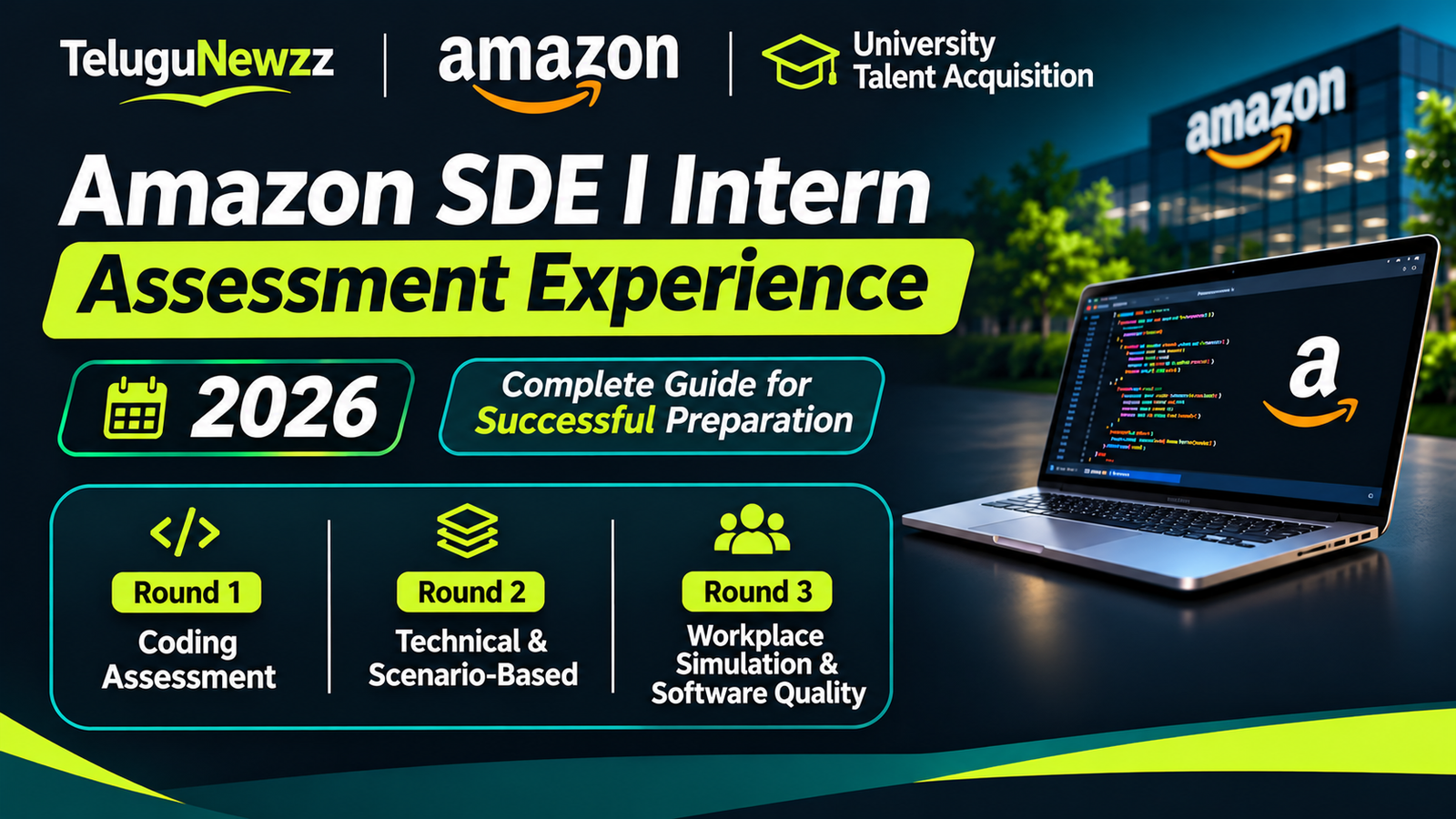
Amazon SDE I Intern Assessment Experience | University Talent Acquisition
Complete assessment breakdown covering coding, technical scenarios, workplace simulation and software quality.
SDE I INTERN
ASSESSMENT EXPERIENCE
Amazon Internship Assessment Details
| Company | Amazon |
| Role | SDE I Intern |
| Recruitment | Amazon University Talent Acquisition |
| Assessment | Online Assessment |
| Assessment Rounds | 3 Rounds |
| Job ID | 10541345 |
Introduction
Recently, a candidate shared their Amazon SDE I Intern Assessment Experience under Amazon University Talent Acquisition.
The online assessment was structured into three rounds, covering different dimensions of software engineering, from coding fundamentals to real-world engineering decisions and workplace scenarios.
Unlike assessments focused only on coding problems, this experience also involved backend debugging, technical decision-making, software quality and team collaboration.
Here is a detailed breakdown of all three assessment rounds based on the candidate’s shared experience.
📚 Table of Contents
Round 1: Coding Assessment
The first round consisted of two coding challenges.
Problem 1: Product Pricing, Promotions and Discount Calculations
The first coding challenge involved problem-solving related to:
- Product pricing calculations.
- Promotional offers.
- Discount calculations.
- Implementing the required business logic.
This problem tested the candidate’s ability to translate business requirements into working code and handle calculation-based programming scenarios.
Problem 2: MERN Stack Backend Debugging
The second challenge involved debugging an existing MERN stack backend application.
The areas covered included:
- REST API debugging.
- MongoDB operations.
- Product creation functionality.
- Product deletion functionality.
- Error handling.
What This Round Tested
Problem-solving ability, implementation skills, backend development knowledge and the ability to debug an existing codebase.
Round 2: Technical and Scenario-Based Assessment
The second round focused on evaluating technical judgment through practical engineering scenarios.
Some of the concepts covered in this round included:
1. Choosing the Right Data Structures
Choosing appropriate data structures for efficient application search.
- HashMap vs TreeMap.
- Trie-based search.
- Efficient search operations.
2. Caching Strategies
Designing caching strategies for frequently accessed product information.
The caching concepts included:
- LRU (Least Recently Used).
- LFU (Least Frequently Used).
- Hybrid cache eviction strategies.
3. Software Release and Testing Decisions
Evaluating how to balance release deadlines with software testing requirements.
The assessment also focused on evaluating technical approaches based on:
- Performance.
- Scalability.
- Memory constraints.
What Made This Round Interesting?
It wasn’t simply about identifying the correct data structure. Understanding the requirements and evaluating trade-offs was equally important.
Round 3: Workplace Simulation and Software Quality
The final round involved simulated workplace scenarios focused on engineering quality and team collaboration.
The scenarios revolved around the following areas:
1. Code Reviews and Deployment Approvals
Understanding code review processes and making appropriate deployment approval decisions.
2. Testing and Edge Cases
- Identifying edge cases.
- Ensuring adequate test coverage.
- Automating testing requirements.
- Preventing untested deployments.
3. Communication and Collaboration
- Communicating risks to teammates and stakeholders.
- Handling situations where delivery deadlines conflict with testing requirements.
4. Production Issues and SOPs
- Root cause analysis of production incidents.
- Establishing Standard Operating Procedures (SOPs).
- Maintaining software quality throughout the development lifecycle.
What This Round Tested
Engineering accountability, collaboration, communication, software testing and maintaining quality throughout the software development lifecycle.
Key Takeaways from the Amazon Assessment
Here are some important lessons the candidate highlighted from the assessment:
1. Strong Coding Fundamentals
Strong coding fundamentals remain essential for software engineering roles.
2. Choosing the Right Data Structure
Choosing the right data structure requires understanding the workload and requirements.
3. Engineering Trade-Offs
Engineering decisions involve evaluating trade-offs, not just knowing definitions.
4. Software Quality
Testing and software quality are essential parts of development.
5. Communication and Collaboration
Communication and collaboration matter just as much as technical implementation.
How to Prepare for Amazon SDE I Intern Assessments?
Based on the topics mentioned in this candidate’s experience, students preparing for similar assessments can focus on the following areas:
Coding and Problem Solving
- Arrays and strings.
- HashMaps and Trees.
- Searching and sorting.
- Mathematical problem-solving.
Backend Development
- REST API development.
- MongoDB CRUD operations.
- Backend debugging.
- Error handling.
System Design Fundamentals
- HashMap vs TreeMap vs Trie.
- LRU and LFU caching.
- Performance and scalability.
- Memory optimization.
Software Engineering Practices
- Code reviews.
- Unit testing and test coverage.
- Deployment approvals.
- Production debugging.
- Root cause analysis.
Explore More Interview Experiences
Looking for more technical interview experiences, coding questions and placement preparation resources?
Official Amazon Preparation Resources
Preparing for Amazon software engineering internships? Explore these official resources to understand the recruitment process, internship opportunities and engineering expectations.
- Amazon SDE Student Programs:
Explore Amazon Software Development Engineer Intern Opportunities - Amazon University Talent:
Explore Student and Graduate Opportunities - Amazon Leadership Principles:
Learn About Amazon’s Leadership Principles
Amazon SDE I Intern – Job Details
| Company | Amazon |
| Position | SDE I Intern |
| Recruitment | University Talent Acquisition |
| Job ID | 10541345 |
What Do You Think?
Do you think engineering assessments should focus more on DSA and coding, or should they also evaluate real-world engineering judgment, debugging and software quality?
Share your thoughts and experiences in the comments!
Disclaimer
This interview experience is based on a candidate-submitted account and is shared for educational and informational purposes. The assessment process, questions and rounds may vary depending on the role, location and recruitment cycle. TeluguNewzz is not affiliated with Amazon. This is not an official Amazon recruitment announcement.
Conclusion
The Amazon SDE I Intern assessment experience highlights how software engineering evaluations can extend beyond traditional coding problems.
From backend debugging and data structure selection to caching strategies, testing and workplace scenarios, the assessment covered multiple aspects of practical software engineering.
Prepare your coding fundamentals, understand engineering trade-offs and practise real-world problem-solving!
Article Tags
Amazon, Amazon Jobs, Amazon Internship, Amazon SDE I Intern, Amazon Assessment Experience, Amazon University Talent Acquisition, SDE Intern Interview, Software Engineering, Coding Assessment, Online Assessment, MERN Stack, MongoDB, REST API, Data Structures, LRU Cache, LFU Cache, Interview Preparation.