INTERVIEW EXPERIENCE · 2026
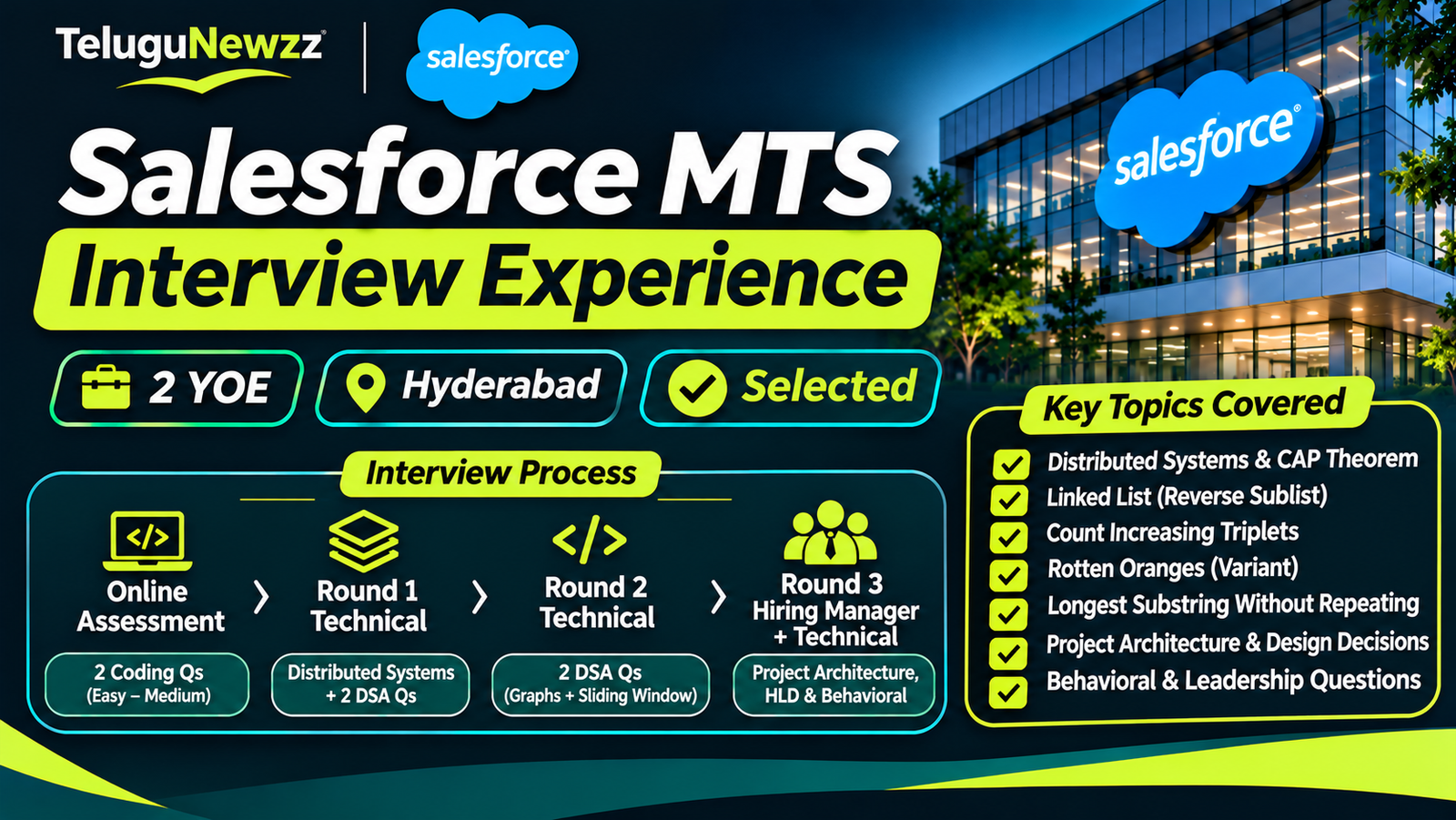
Salesforce MTS Interview Experience – 2 Years Experience | Hyderabad
Complete recruitment journey covering Online Assessment, Distributed Systems, DSA, project architecture and Hiring Manager interview.
2 YOE
HYDERABAD
Salesforce MTS Interview Details
| Company | Salesforce |
| Position | Member of Technical Staff (MTS) |
| Location | Hyderabad, India |
| Experience | Approximately 2 Years |
| Education | Tier-1 College |
| Interview Process | Online Assessment + 3 Offline Rounds |
| Final Result | Selected – Offer Received |
Introduction
Looking for a Salesforce MTS Interview Experience for candidates with around 2 years of experience? This candidate-reported interview journey from Hyderabad provides useful insights into the company’s technical recruitment process.
The selection process consisted of one Online Assessment followed by three offline interview rounds. The interviews covered Data Structures and Algorithms, Distributed Systems, CAP Theorem, project discussions, architecture and managerial questions.
The candidate successfully cleared all the rounds and received a verbal selection confirmation on August 6, followed by the official offer letter on August 28.
Interview Highlights
- Two Easy-to-Medium coding questions in the Online Assessment.
- Distributed Systems and CAP Theorem discussion.
- Reverse a Sublist in a Linked List.
- Count Increasing Triplets.
- Rotten Oranges variation.
- Longest Substring Without Repeating Characters.
- Project architecture and leadership discussions.
Note: This article is based on an anonymous candidate’s shared interview experience. The questions and recruitment process may vary across teams and hiring cycles.
Table of Contents
1. Salesforce Recruitment Timeline
The candidate shared the following timeline for the Salesforce MTS recruitment process:
Received a call from the Salesforce recruiter.
Received and completed the Online Assessment process.
All three offline interview rounds were conducted on the same day.
Received verbal confirmation of selection.
Received the official offer letter.
2. Online Assessment (OA)
The Salesforce Online Assessment consisted of two coding questions at Easy-to-Medium difficulty level.
The candidate successfully solved both questions within the allotted time.
Assessment Summary
- Number of questions: 2.
- Difficulty: Easy to Medium.
- Performance: Both questions solved.
3. Round 1 – Technical Interview
The first technical round started with a brief introduction and a discussion about the candidate’s previous experience and projects.
Part 1: Distributed Systems Questions
Based on the candidate’s project experience, the interviewer asked several questions related to Distributed Systems.
Questions Asked
- What is a Distributed System?
- What is the CAP Theorem?
- Which CAP theorem constraints does your system follow?
- Why did you choose that particular architecture?
- Why are Distributed Systems necessary?
Important Concept: CAP Theorem
The CAP Theorem is an important concept in Distributed Systems. It describes three properties:
Every read receives the most recent successful write or an error.
Every request to a non-failing node receives a response, even if the response may not contain the latest data.
The system continues operating despite communication failures between network partitions, subject to its consistency and availability trade-offs.
A key interview discussion is understanding how a distributed system handles network partitions and the trade-offs between consistency and availability.
Part 2: DSA Question 1 – Reverse a Sublist in a Linked List
Problem Statement
Given the head of a linked list, a starting position and a length, reverse the specified portion of the linked list.
Requirements
- Start with the given head of the linked list.
- Identify the specified starting position.
- Reverse the required portion of the linked list.
- Maintain the remaining linked list connections.
- Return the updated head of the linked list.
Concepts to Practise
Linked List Traversal, Pointer Manipulation, In-place Reversal and Edge Cases.
Related Practice: LeetCode – Reverse Linked List II →
Part 3: DSA Question 2 – Count Increasing Triplets
Problem Statement
Given an array of integers, find the number of triplets of indices (i, j, k) satisfying the following conditions:
arr[i] < arr[j] < arr[k]
Count all possible triplets that satisfy both the index ordering and strictly increasing value conditions.
Concepts to Practise
- Array Traversal.
- Brute Force Approach.
- Prefix and Suffix Counting.
- Binary Indexed Tree (Fenwick Tree).
- Coordinate Compression.
- Dynamic Programming.
The interviewer can evaluate both the basic approach and the optimization needed for larger input sizes.
Distributed Systems, CAP Theorem, Linked Lists, Pointer Manipulation and Increasing Triplets.
4. Round 2 – Technical Interview
The second technical round primarily focused on Data Structures and Algorithms. The interviewer asked two coding questions.
Question 1: Rotten Oranges – Variant
Problem Statement
This question was based on a variation of the standard Rotten Oranges problem, involving the spread of rot across a grid.
The candidate was expected to understand how the state of the grid changes as the rot spreads and solve the modified problem.
Concepts to Practise
- Breadth-First Search (BFS).
- Queue Data Structure.
- Grid Traversal.
- Multi-source BFS.
- Direction Arrays.
Related Practice: LeetCode – Rotting Oranges →
Question 2: Longest Substring Without Repeating Characters
Problem Statement
Given a string, find the length of the longest substring without repeating characters.
A substring must contain consecutive characters from the original string, and no character should appear more than once within the selected substring.
Example
Input
s = “abcabcbb”
Output
3
Explanation
The longest substring without repeating characters is “abc”, with a length of 3.
Optimal Approach: Sliding Window
- Maintain two pointers representing the current window.
- Use a HashMap or array to track character positions.
- Move the left pointer when a repeated character is found.
- Update the maximum window length.
Expected complexity: O(n) time using a suitable character-position tracking structure.
Related Practice: LeetCode – Longest Substring Without Repeating Characters →
BFS, Graph Traversal, Grid Problems, Queue, HashMap and Sliding Window.
5. Round 3 – Hiring Manager + Technical Interview
The final round was conducted by a VP and was primarily managerial in nature, with significant technical discussions.
The interviewer reviewed the candidate’s resume in detail and asked questions about:
- Current role and responsibilities.
- Previous professional experience.
- Projects and technical contributions.
- Project architecture and design.
- Technology and architectural choices.
Important Discussion Areas
Explain the overall architecture and how different components interact.
Why did you choose a particular technology or approach over available alternatives?
Explain the reasoning behind important design and implementation decisions.
What challenges did you face in your projects, and how did you address them?
Discuss ownership, collaboration, decision-making and leadership-related experiences.
Although this round was initially expected to be an LLD interview, the discussion shifted towards project architecture and high-level design.
Several follow-up questions challenged the candidate’s design choices. Therefore, having a clear understanding of the reasoning behind every technical decision was important.
Do not just explain what you built. Be prepared to explain why you built it that way, what alternatives you considered and what trade-offs you evaluated.
6. Final Selection and Offer
SUCCESSFULLY SELECTED
Salesforce MTS
Hyderabad · Approximately 2 YOE
August 6
Verbal selection confirmation received.
August 28
Official offer letter received.
The candidate successfully cleared the Online Assessment and all three offline interview rounds, receiving verbal confirmation before the official offer letter arrived.
7. How to Prepare for Salesforce MTS Interviews?
Based on this Salesforce MTS Interview Experience, candidates with around 2 years of experience can focus on the following areas.
Data Structures and Algorithms
- Linked List Reversal.
- Increasing Triplets.
- BFS and DFS.
- Grid-based Problems.
- Sliding Window.
- HashMap and Arrays.
Distributed Systems
- Distributed Systems Fundamentals.
- CAP Theorem.
- Consistency and Availability.
- Partition Tolerance.
- Distributed System Architecture.
- Technology Selection and Trade-offs.
Project Preparation
- End-to-End Project Architecture.
- Technology and Framework Selection.
- High-Level Design.
- Technical Challenges.
- Scalability and Reliability.
- Alternative Design Approaches.
Behavioural Preparation
- Ownership and Accountability.
- Leadership Experiences.
- Handling Technical Challenges.
- Team Collaboration.
- Explaining Project Contributions.
8. Overall Interview Experience
Overall, the Salesforce MTS recruitment process was a combination of coding, Distributed Systems fundamentals, project deep dives and managerial discussions.
The most important preparation areas highlighted by the candidate were:
- Practising standard DSA patterns, especially Sliding Window, Linked Lists and Graphs.
- Understanding Distributed Systems fundamentals and the CAP Theorem.
- Having a strong understanding of projects and architectural decisions.
- Preparing behavioural and leadership-related questions.
9. Frequently Asked Questions
The candidate had approximately 2 years of Software Engineering experience.
The process consisted of one Online Assessment followed by three offline interview rounds.
The reported questions included Reverse a Sublist in a Linked List, Count Increasing Triplets, Rotten Oranges variation and Longest Substring Without Repeating Characters.
Yes. The first technical interview included questions on Distributed Systems, CAP Theorem and architecture decisions.
The candidate received verbal confirmation on August 6 and the official offer letter on August 28.
Explore More Interview Experiences
Discover more company-wise interview experiences, DSA questions and technical interview preparation resources.
Useful Coding Practice Resources
Practise the coding patterns discussed in this interview using the following problems:
Disclaimer
This interview experience is based on an anonymous candidate’s shared account and is published for educational and interview preparation purposes. Interview questions, recruitment stages, timelines and selection criteria may vary depending on the role, team and hiring cycle. TeluguNewzz is an independent career information platform and is not affiliated with Salesforce.
Conclusion
This Salesforce MTS Interview Experience provides useful insights into the technical recruitment process for candidates with around 2 years of experience.
From DSA questions and Distributed Systems to project architecture and leadership discussions, the interviews tested both technical fundamentals and practical engineering knowledge.
Strong coding skills, a clear understanding of your projects and the ability to explain technical decisions can make a meaningful difference during interviews.
Prepare consistently, strengthen your fundamentals and keep moving towards your career goals!
Article Tags
Salesforce, Salesforce MTS, Salesforce Interview Experience, Salesforce Jobs, Salesforce Hyderabad, Member of Technical Staff, 2 Years Experience, Distributed Systems, CAP Theorem, Linked List Interview Questions, Increasing Triplets, Rotten Oranges, Sliding Window, Longest Substring Without Repeating Characters, Software Engineer Interview, Technical Interview Experience.