INTERVIEW EXPERIENCE
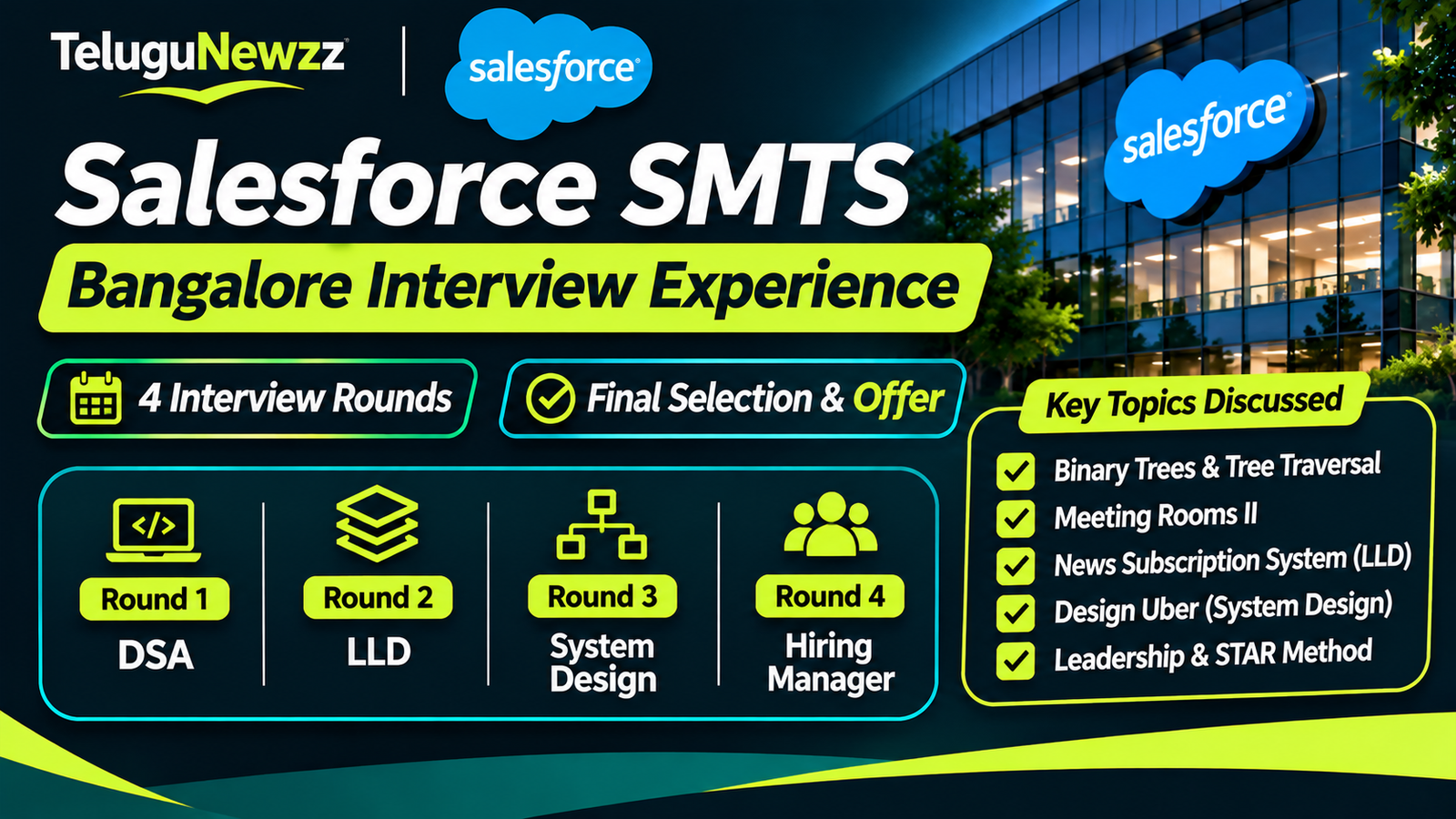
Salesforce SMTS Bangalore Interview Experience – DSA, LLD, System Design & Offer
Complete candidate-reported interview journey covering four rounds, technical questions, system design and final selection.
SMTS
BANGALORE
Salesforce SMTS Interview Details
| Company | Salesforce |
| Role | SMTS |
| Location | Bangalore |
| Recruitment Process | Online Assessment + 4 Interview Rounds |
| Interview Topics | DSA, LLD, System Design, Leadership |
| Final Outcome | Selected – Offer Received |
Introduction
Looking for a Salesforce SMTS Interview Experience? This candidate-reported experience from Bangalore provides a detailed look at the recruitment process, including the online assessment, technical interviews and final Hiring Manager discussion.
The selection process consisted of an online assessment followed by three technical rounds and an on-site Hiring Manager round.
The technical interviews covered Binary Trees, Meeting Rooms II, Low-Level Design, System Design, Uber architecture, cloud systems and leadership-related questions.
After completing all the rounds, the candidate received the selection call on 5 November and the official offer letter on 6 November.
Interview Highlights
- Online assessment and recruiter screening.
- DSA round with two coding questions.
- LLD: News Alert and Subscription System.
- System Design: Design Uber.
- Hiring Manager round using the STAR method.
- Final selection and offer letter.
Note: This article is based on one anonymous candidate’s shared interview experience. The questions and recruitment process may vary for other candidates.
Table of Contents
1. Salesforce Hiring Process
The recruitment journey started when the candidate received an email from a Salesforce recruiter on 7 October.
Here is the reported recruitment timeline:
Received an email from a Salesforce recruiter regarding an opportunity.
Received the online assessment link.
Completed the online assessment. The recruiter informed the candidate that the resume would be shared with the Hiring Manager.
Recruiter called and explained the upcoming interview process: three consecutive technical rounds followed by an on-site Hiring Manager round.
Round 1 – DSA.
Round 2 – Low-Level Design.
Round 3 – System Design.
Round 4 – On-site Hiring Manager interview.
Received the selection call and Offer of Intent.
Received the official offer letter.
2. Round 1 – DSA Interview
The first technical round focused on Data Structures and Algorithms. The interviewer asked two coding questions.
Question 1: Group Identical Levels in a Binary Tree
Problem Statement
Given a binary tree, traverse the tree level by level and collect the node values at each level from left to right.
The task is to group levels that have identical sequences of node values and print only the groups that appear more than once.
Requirements
- Perform level-order traversal of the binary tree.
- Collect each level’s node values from left to right.
- Compare the sequences obtained from different levels.
- Group levels with identical sequences.
- Print only groups that occur more than once.
Interview Discussion
The interviewer first asked for a brute-force approach and then expected the candidate to improve it towards an optimal solution.
The problem involved tree traversal and sequence comparison rather than a direct copy of a typical coding-platform problem.
Related Practice Problem
Practise Binary Tree Level Order Traversal:
LeetCode – Binary Tree Level Order Traversal →
Question 2: Meeting Rooms II
Problem Statement
Given an array of meeting time intervals, determine the minimum number of conference rooms required to accommodate all meetings without overlapping.
Key Concepts
- Sorting intervals.
- Priority Queue / Min Heap.
- Meeting overlap detection.
- Time and space complexity analysis.
The candidate explained different possible approaches, followed by the optimal solution. The interviewer also asked for a dry run of the example and a discussion of time and space complexity.
The discussion went well, and the interviewer appeared comfortable with both solutions.
Practise Meeting Rooms II on LeetCode →
Binary Trees, Level Order Traversal, Arrays, Sorting, Heaps and complexity analysis.
3. Round 2 – Low-Level Design (LLD)
The second round started with a discussion about the candidate’s previous and current projects.
The interviewer also asked deeper questions about cloud systems before moving to the design problem.
Design a News Alert and Subscription System
Problem Statement
Design a news alert and subscription system that allows users to subscribe to news topics and receive relevant notifications based on their preferences.
The discussion focused on four main components:
Receiving and processing incoming news information.
Managing the topics and categories users want to follow.
Matching incoming news with relevant user preferences.
Delivering relevant alerts to subscribed users.
Important Follow-up Question
If a user changes their preferences, which services or components of the system would be affected?
The candidate explained the key classes, their fields and methods, and the complete end-to-end flow.
Concepts to Prepare
- Object-Oriented Programming.
- Classes and Objects.
- Interfaces and Abstraction.
- Composition and Relationships.
- Low-Level System Design.
- Event-driven Architecture.
- Notification Services.
4. Round 3 – System Design Interview
The third round started with discussions about the candidate’s current projects and leadership-related topics.
System Design Question: Design Uber
Problem Statement
Design a ride-hailing platform similar to Uber.
The interviewer provided the requirements, and the candidate worked through the functional and non-functional requirements before presenting a high-level system design.
Key Discussion Areas
- Functional requirements.
- Non-functional requirements.
- High-level system architecture.
- Driver matching.
- Maps and location-related functionality.
The interview included deeper discussions around driver matching and maps.
Interviewer Feedback
After the round, the recruiter shared that the DSA and LLD rounds had gone well, while the System Design round was considered okay. The candidate was invited to continue to the on-site Hiring Manager round.
Concepts to Prepare
- System Design Fundamentals.
- Functional and Non-Functional Requirements.
- Scalability and Availability.
- Driver Matching Algorithms.
- Geospatial Data and Maps.
- Service Communication.
5. Round 4 – Hiring Manager Interview
The final round was an on-site Hiring Manager interview.
The interviewer had already reviewed the candidate’s resume and current project.
Leadership and Behavioural Question
The candidate was asked to describe a complex project they had worked on and explain what made it challenging.
The answer was structured using the STAR method:
Describe the project and the situation.
Explain your responsibilities and objectives.
Explain the actions you personally took to overcome the challenge.
Describe the outcome and impact of your actions.
The final part of the discussion focused on the company and team culture.
The interviewer also mentioned that the team was looking for someone who could join soon.
6. Final Selection and Offer
SUCCESSFULLY SELECTED
Salesforce SMTS
Bangalore
5 November
Received the selection call and Offer of Intent.
6 November
Received the official offer letter.
The candidate shared that the journey included rejections, multiple interviews, extensive preparation and moments of self-doubt.
After continuing the preparation and completing all the interview rounds, the candidate successfully received an offer from Salesforce.
7. How to Prepare for Salesforce SMTS Interviews?
Based on the questions and discussions in this interview experience, candidates preparing for similar software engineering interviews can focus on these topics.
Data Structures and Algorithms
- Binary Tree Traversal.
- Level Order Traversal.
- Meeting Rooms II.
- Sorting and Priority Queues.
- Time and Space Complexity.
Low-Level Design
- Object-Oriented Programming.
- Class and Interface Design.
- News Subscription Systems.
- Notification Services.
- Service Dependencies.
System Design
- Design Uber.
- Driver Matching.
- Location and Maps.
- Scalability and Reliability.
- Functional and Non-Functional Requirements.
Behavioural and Leadership
- STAR method.
- Complex project discussions.
- Leadership and ownership.
- Problem-solving experiences.
- Team collaboration.
Explore More Interview Experiences
Discover more company-wise interview experiences, DSA questions, technical interview preparation and career resources.
Useful Interview Preparation Resources
Practise the coding problems discussed in this interview and explore official Salesforce career opportunities.
Disclaimer
This interview experience is based on an anonymous candidate’s shared account and is published for educational and interview preparation purposes. Interview questions, recruitment stages, timelines and selection criteria may vary depending on the role, team and hiring cycle. No individual candidate identity has been disclosed. TeluguNewzz is an independent career information platform and is not affiliated with Salesforce.
Conclusion
This Salesforce SMTS Bangalore interview experience highlights the importance of strong DSA fundamentals, Low-Level Design, System Design and behavioural interview preparation.
The four interview rounds covered practical coding problems, a news subscription system, Uber architecture and a leadership discussion using the STAR method.
The candidate’s journey also highlights the importance of consistency, learning from rejections and preparing thoroughly for every interview stage.
Keep learning, keep practising and never give up on your career goals!
Article Tags
Salesforce, Salesforce Jobs, Salesforce SMTS, Salesforce Interview Experience, Salesforce Bangalore, SMTS Interview Questions, DSA Interview, Binary Tree, Meeting Rooms II, Low Level Design, System Design Interview, Uber System Design, Hiring Manager Interview, STAR Method, Software Engineer Interview Experience.