CAMPUS PLACEMENT · INTERVIEW EXPERIENCE
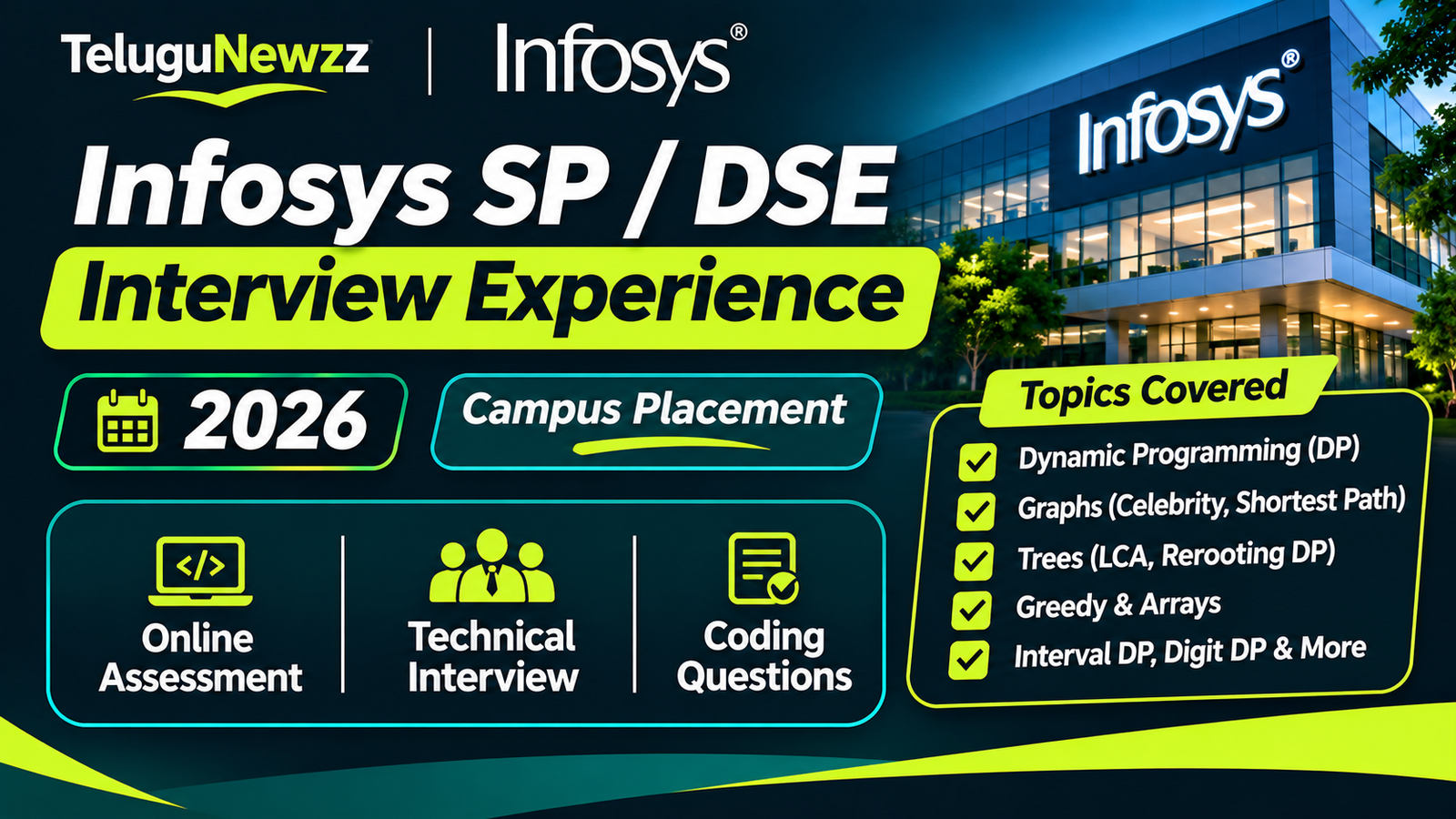
Infosys SP DSE Interview Experience 2026 – Coding Questions, Online Assessment & Technical Interview
Explore candidate-reported Infosys Specialist Programmer and Digital Specialist Engineer recruitment experiences, coding problems and preparation strategies.
SP / DSE
2026
Introduction
Preparing for the Infosys SP/DSE Interview Experience 2026? Infosys Specialist Programmer (SP) and Digital Specialist Engineer (DSE) recruitment processes can involve challenging coding problems, technical interviews and advanced data structures and algorithms.
Several candidates have shared their Infosys campus recruitment experiences, including online coding assessments, face-to-face technical interviews and questions involving Dynamic Programming, Graphs, Trees, Greedy Algorithms and other DSA concepts.
This article brings together the reported interview experiences and coding questions shared by candidates. It covers the different assessment patterns, technical topics and problem statements to help students prepare for similar recruitment drives.
Article Highlights
- Infosys SP/DSE online assessment experience.
- Technical interview questions and DSA topics.
- Dynamic Programming and Graph problems.
- Tree, LCA and shortest-path questions.
- Four additional coding problem statements.
- Preparation strategy for SP/DSE recruitment.
Note: The experiences below come from multiple candidate-reported accounts. They are presented separately because assessment questions and interview rounds can vary across candidates and campus recruitment drives.
Table of Contents
1. Infosys SP/DSE Interview Experience – Campus Recruitment
Infosys visited a campus and conducted its recruitment drive for Specialist Programmer and Digital Specialist Engineer roles.
The reported selection process included an online assessment followed by a face-to-face technical interview.
Round 1: Online Assessment
CODING ASSESSMENT
- Three coding questions.
- Questions were reportedly at LeetCode Medium to Hard level.
- Problems involved Dynamic Programming, Graphs and Greedy Algorithms.
- Solving one question completely and passing partial test cases in the remaining questions was reported as sufficient to progress in this particular experience.
The online assessment focused on problem-solving ability, algorithm selection and the implementation of efficient solutions.
Round 2: Technical Interview
Interview mode: Face-to-face at the Chandigarh office.
The technical interview was mainly resume-based and included project discussions, computer science fundamentals and DSA problems.
Topics discussed:
- Questions based on the candidate’s resume.
- Basic project-related questions.
- Computer science fundamentals.
- Graph problem commonly known as the Celebrity Problem.
- Finding an efficient approach using a Stack.
- Shortest Path problem based on Dijkstra’s Algorithm.
- A modification of the shortest-path problem into a Dynamic Programming discussion.
Additional Interview Question
The interviewer also asked why the candidate wanted to work as a Software Developer despite having an Electronics and Communication Engineering (ECE) background.
The candidate reported that the recruitment result was received approximately 2.5 months after the interview.
2. Infosys Online Assessment and Selection Experience
Another candidate-reported experience described an online assessment followed by onsite and offsite interview rounds.
Online Assessment
The reported assessment included four coding questions:
- Question 1: Easy Array problem.
- Question 2: Dynamic Programming.
- Question 3: Interval Dynamic Programming.
- Question 4: Digit Dynamic Programming.
The candidate reported solving three questions in the assessment.
Onsite Interview
The onsite interview reportedly included:
- One basic Mathematics problem.
- A harder variation of the Coin Change problem.
Offsite Interview
Dynamic Programming was reported as a major focus across the onsite and offsite rounds.
Reported Outcome
The candidate reported being selected for L1.
3. Infosys SP/DSE Coding Questions – Trees and Graphs
The following problem statements were shared as part of the reported coding-question discussion. They are useful for practising tree algorithms, graph traversal and rerooting techniques.
Question 1: Minimum Sum Over All Root-to-Leaf Paths
Problem Statement
You are given an undirected tree with N nodes numbered from 1 to N.
Each node i has an associated value A[i].
For every possible choice of root r:
- Root the tree at node r.
- Consider every root-to-leaf path.
- For each path, calculate the sum of node values excluding the root r but including every other node on the path.
- Let F(r) represent the sum of these values over all root-to-leaf paths.
Your task is to calculate:
Over all possible choices of root r.
Input
- N – Number of nodes.
- Array A of length N.
- N-1 undirected edges describing the tree.
Output
Output the minimum possible value of F(r) over all possible root choices.
Concepts to Practise
Tree Traversal, DFS, Tree DP, Rerooting DP and Subtree Calculations.
Question 2: Lowest Common Ancestor with Variable Root
Problem Statement
You are given an undirected tree consisting of N nodes numbered from 1 to N.
You need to answer Q independent queries. Each query contains three integers (r, u, v).
For every query:
- Consider the tree rooted at node r.
- Find the Lowest Common Ancestor (LCA) of nodes u and v with respect to this root.
Input
- N – Number of nodes.
- N-1 undirected edges describing the tree.
- Q – Number of queries.
- Each query contains r, u and v.
Output
For each query, output the LCA of u and v when the tree is rooted at r.
Concepts to Practise
Lowest Common Ancestor, Binary Lifting, DFS, Euler Tour and Tree Traversal.
Question 3: Partition an Array into K Non-Overlapping Subarrays
Problem Statement – Partial Reconstruction
Given an array, partition it into K non-overlapping subarrays and calculate a minimum or maximum value based on the resulting partitions.
The shared description mentions partitioning the array into K non-overlapping subarrays and finding Min/Max.
Concepts to Practise
Partition DP, Interval DP, Prefix Sums and Optimization.
IMPORTANT
The original description does not specify the exact objective function, input format or constraints. This question is retained as a partial problem statement rather than inventing missing conditions.
4. Four Additional Infosys Coding Questions
The following four problems were shared as another coding-question set. They cover arrays, greedy strategies, number theory and graph algorithms.
Question 1: Merge Adjacent Array Elements
Problem Statement
Given an array containing N elements, you can merge adjacent elements in any order if their sum is less than K.
Your task is to return the length of the array after performing all valid merges.
Key Requirements
- The elements must be adjacent to perform a merge.
- The sum of the two elements must be less than K.
- Merging can be performed in any valid order.
- Return the final length of the array.
Concepts to Practise
Arrays, Greedy Algorithms, Simulation and Edge Cases.
Question 2: Maximize Score with Even Result
Problem Statement
Given an array, your task is to maximize the score. The returned score must be even.
Score: The sum of the selected elements.
The selection follows this movement rule:
- If you choose an element at index i, you must move to index i + (arr[i] % 2).
Your task is to determine the maximum possible even score under the given movement rule.
Concepts to Practise
Array Traversal, Greedy Algorithms, Dynamic Programming, Parity and Optimization.
PROBLEM DETAILS
The original shared description does not specify the starting index, movement termination rule or whether indices outside the array are allowed. These details are required to determine an exact solution.
Question 3: Count Arrays Using GCD and LCM Conditions
Problem Statement
Given four integers N, M, G and L, find the number of arrays of size N that can be formed using integers from 1 to M such that the following conditions are satisfied:
Condition 1: Odd Index
For odd index i:
Condition 2: Even Index
For even index i:
Input
- N – Size of the array.
- M – Maximum allowed integer value.
- G – GCD threshold.
- L – LCM threshold.
Output
Return the number of arrays satisfying the given conditions.
Concepts to Practise
Number Theory, GCD, LCM, Combinatorics, Dynamic Programming and Modular Arithmetic.
Question 4: Graph Paths with Cyclic Adjacency Matrix Shifts
Problem Statement
Given a graph with N nodes and its adjacency list, perform the following task:
- Find all paths from node 1 to node N whose path length is K.
- For every move from one node to another, the adjacency matrix undergoes a right cyclic shift of its rows.
Main Requirements
- Start from node 1.
- Reach node N.
- Consider paths with length K.
- Apply the specified right cyclic row shift after every move.
Concepts to Practise
Graph Traversal, BFS, DFS, Adjacency Matrix, State-Space Search and Dynamic Programming.
PROBLEM DETAILS
The shared description does not define the exact cyclic shift operation, path-length convention or whether repeated vertices are allowed. These conditions are needed for a complete implementation.
5. Important Topics to Prepare for Infosys SP/DSE
Based on the reported questions, candidates preparing for Infosys SP/DSE recruitment can prioritize the following topics.
Dynamic Programming
- Basic Dynamic Programming.
- Interval DP.
- Digit DP.
- Tree DP.
- Partition DP.
- Coin Change.
- State transitions and optimization.
Graphs
- BFS and DFS.
- Dijkstra’s Algorithm.
- Shortest Path Problems.
- Celebrity Problem.
- Graph Traversal.
- Adjacency Matrix and Adjacency List.
Trees
- Binary Trees.
- Tree Traversal.
- Lowest Common Ancestor.
- Binary Lifting.
- Rerooting DP.
- Subtree Calculations.
Greedy and Arrays
- Greedy Algorithms.
- Array Manipulation.
- Prefix Sums.
- Interval Problems.
- Parity-based Optimization.
- Sorting and Searching.
Number Theory
- GCD and LCM.
- Prime Numbers.
- Modular Arithmetic.
- Combinatorics.
6. Frequently Asked Questions
1. What coding topics were reported in Infosys SP/DSE assessments?
Reported topics included Dynamic Programming, Graphs, Greedy Algorithms, Trees, Arrays, Number Theory, Interval DP and Digit DP.
2. What is the difficulty level of Infosys SP coding questions?
One candidate described the online assessment questions as LeetCode Medium to Hard level. Difficulty can vary across recruitment drives.
3. Is Dynamic Programming important for Infosys SP/DSE?
Dynamic Programming was a recurring topic in the shared experiences, including Interval DP, Digit DP, Tree DP and Coin Change variations.
4. Are technical interviews based on resumes?
One reported technical interview focused mainly on the candidate’s resume, projects, computer science fundamentals and DSA problems.
5. How long can Infosys recruitment results take?
One candidate reported receiving the result approximately 2.5 months after the interview. Actual timelines vary.
Explore More Interview Experiences
Discover more company-wise interview experiences, programming questions and placement preparation resources.
Official Infosys Career Resources
For official recruitment information and career opportunities, visit the Infosys careers website.
Disclaimer
This article compiles candidate-reported Infosys SP/DSE interview experiences and coding-question descriptions for educational and interview preparation purposes. The recruitment process, questions, difficulty and selection criteria may vary by campus, candidate and recruitment cycle. Some problem statements were shared in incomplete form and have been clearly marked as partial reconstructions. TeluguNewzz is an independent career information platform and is not affiliated with Infosys.
Conclusion
The reported Infosys SP/DSE interview experiences highlight the importance of strong problem-solving skills, advanced DSA knowledge and a clear understanding of algorithmic concepts.
Dynamic Programming, Graph Algorithms, Tree DP, LCA, Greedy Algorithms and Number Theory are particularly useful areas to practise based on the questions shared here.
Practise consistently, understand the logic behind every problem and prepare for real-world technical discussions!
Article Tags
Infosys, Infosys SP, Infosys DSE, Infosys Specialist Programmer, Infosys Digital Specialist Engineer, Infosys Interview Experience 2026, Infosys Coding Questions, Infosys Campus Recruitment, Dynamic Programming, Interval DP, Digit DP, Tree DP, Graph Algorithms, Greedy Algorithms, LCA, Dijkstra Algorithm, Coin Change, DSA Interview Questions, Freshers Interview Preparation.